
How to remove mats from your dog's coat (without hurting them)
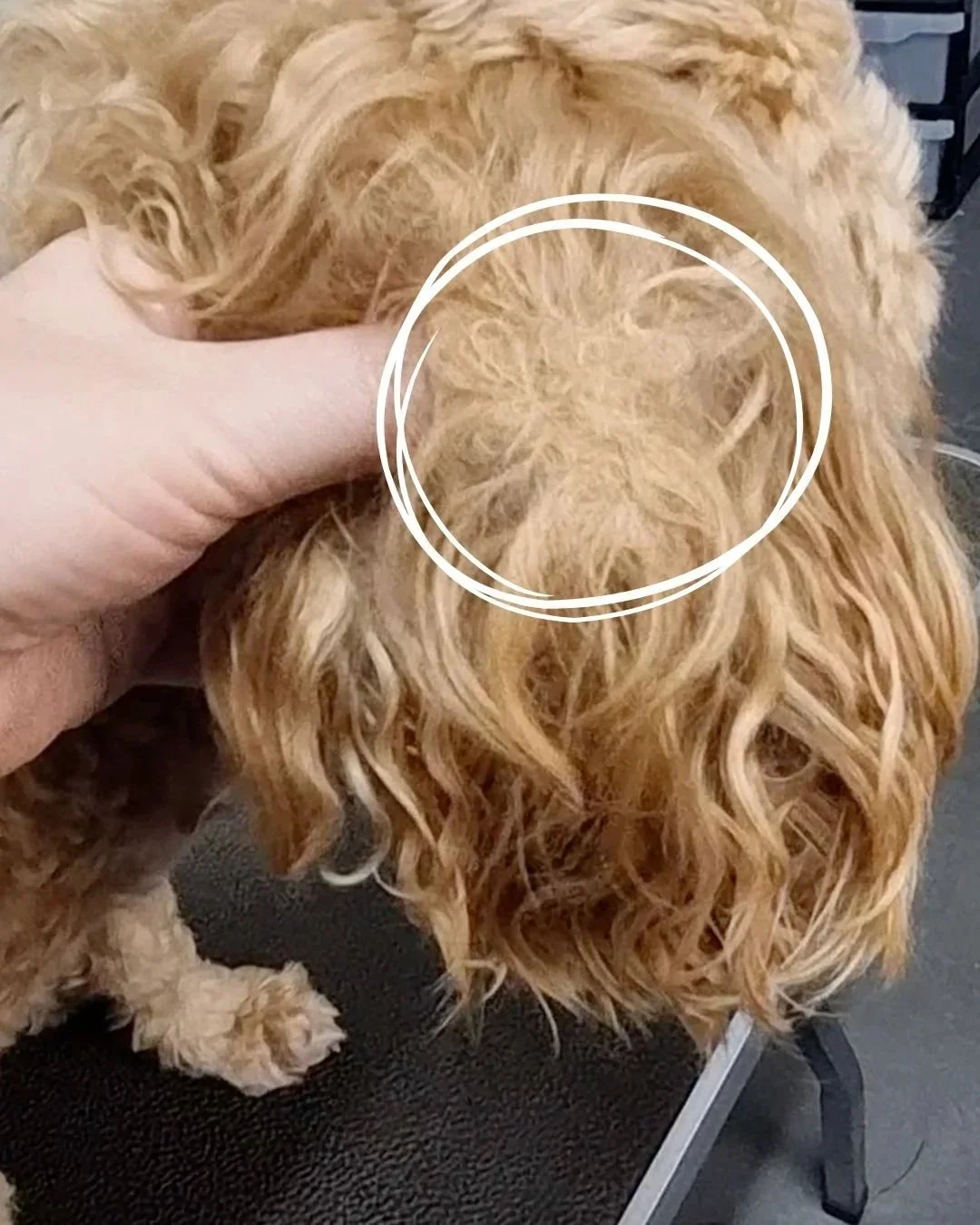
Mats are one of the most common grooming problems in dogs with long, curly and double coats, including Cavoodles, Groodles, Labradoodles, Spoodles, Golden Retrievers and Border Collies. While they might look harmless at first, mats can quickly become tight against the skin, making grooming uncomfortable and, in severe cases, causing pain and skin irritation.
The good news is that many mats can be safely removed at home if you catch them early and use the right tools.
In this guide, I'll show you the different ways to remove dog mats, when to brush them out, when to use a de-matting comb, and when it's safest to shave them off.
Why do dogs get mats?
A mat usually starts as a few small tangles that become tightly woven together over time.
As your dog walks, runs and plays, friction causes the hairs to twist around each other until they form a dense clump of fur. Mats also trap dirt, moisture and debris against the skin, making them progressively tighter and more uncomfortable.
If left in the coat, mats can:
Pull painfully on your dog's skin
Restrict movement
Trap moisture against the skin
Cause hot spots and skin infections
Make grooming much more difficult
The earlier you remove a mat, the easier it will be.
Where do mats commonly form?
Mats almost always develop in areas where the coat experiences constant friction.
Common places to check include:
Behind the ears
Under the collar
Under a harness
Armpits
Under the tail
Around the sanitary area
Anywhere clothing or jackets rub
Between the paw pads
Checking these areas and brushing them a few times each week can prevent small tangles from becoming painful mats.
Preventing mats
To help prevent mats:
Brush your dog several times a week.
Remove their collar, harness and clothing before brushing.
Brush before and after every bath.
Dry their coat thoroughly after bathing.
One of the biggest mistakes owners make is bathing a matted coat.
Water actually tightens mats as they dry, making them much harder, and often more painful to remove afterwards. Always remove mats before bathing whenever possible.
What you'll need
Before you begin, you'll need:
How to remove mats from your dog's coat
1. Start with a slicker brush
For smaller mats and tangles, your slicker brush may be all you need.
The key is to hold the fur between the skin and the mat while brushing. This prevents the pulling force from transferring to your dog's skin and makes the process much more comfortable.
Brush gently in short strokes.
If the mat starts to loosen, use your fingers to carefully tease apart the fur before brushing again.
After brushing with your slicker brush, run a metal comb through the coat. If the comb catches, there's still a knot hiding underneath.
2. Use a de-matting comb
If brushing isn't enough, it's time to use a de-matting tool.
A de-matting comb uses small serrated blades to slice through the tangled hairs, breaking the mat into smaller pieces without removing large chunks of coat.
Again, hold the fur between the skin and the mat to minimise pulling while gently combing through it.
As the mat begins to separate, use your fingers to pull the loosened sections apart.
Continue until the de-matting comb glides through easily.
Once it does, switch back to your slicker brush.
You may need to alternate between the de-matting comb and slicker brush several times before the coat is completely knot-free.
After brushing with your slicker brush, run a metal comb through the coat. If the comb catches, there's still a knot hiding underneath.
3. Carefully cut through larger mats
If a mat is particularly thick, you can carefully make a few small cuts into the mat with straight grooming scissors to help break it apart before using your de-matting comb.
This helps reduce the amount of pulling required.
Always cut into the mat, not towards your dog's skin.
4. When scissors are the better option
Sometimes it's simply quicker and less painful to cut the mat out.
This is often the best option if:
Your dog becomes uncomfortable while de-matting
Your dog is elderly and can't stand for long
You're happy to lose a small amount of coat
The downside is that cutting out a mat leaves a noticeable hole in the coat.
5. Use mini trimmers for delicate areas
Some areas are simply too risky for scissors.
I recommend using mini trimmers to remove mats from:
Behind the ears
Armpits
Between the paw pads
Around the sanitary area
Around the bum
Mini trimmers are much easier to manoeuvre into tight spaces and significantly reduce the risk of accidentally cutting delicate skin.
If you'd like to learn more, read my guide: 5 dog grooming tasks mini trimmers are perfect for
6. Shave severe mats
If a mat is tightly against the skin and you can't safely slide a de-matting comb or scissors underneath it, don't try to force it.
The safest option is to carefully shave underneath the mat using dog clippers.
Attempting to cut tightly matted fur with scissors is one of the most common causes of grooming injuries because the skin is often pulled up into the mat and can't be seen.
When should you see a professional groomer?
If your dog's coat is heavily matted or the mats are tight against the skin over large areas of the body, it's usually safest to visit a professional groomer.
You should also seek professional help if:
Your dog won't tolerate mat removal
The mats are close to the eyes
The mats cover large sections of the body
The skin underneath looks sore or infected
You can't safely get underneath the mat
In some cases, your veterinarian may need to remove severe mats if they've caused skin damage.
Watch my step-by-step video
Want to see exactly how I remove mats from a dog's coat?
In the video below, I'll demonstrate the different techniques I use as a professional dog groomer, including when to use a slicker brush, a de-matting comb, scissors, mini trimmers and clippers. I'll also show you the areas where mats commonly form and explain the safest way to remove them without causing unnecessary discomfort for your dog.
Watch my full step-by-step tutorial and groom along with me >
I’m a qualified dog groomer and fur-mum to two cavoodles; Soda and Poppy. I’m passionate about the health and wellbeing of dogs, as well as helping dog parents groom their dogs at home. I’ll teach you the basics, however if you don’t feel comfortable or confident at any time that’s completely fine, book your dog in for a regular groom and pamper session at the salon. Please never leave your dog unattended on a grooming table.
Disclosure: Healthy Happy Paws is a reader supported website. If you purchase products through links on this website we may earn a small commission at no additional cost to you.