
15 Essential tools for DIY dog grooming

When it comes to dog grooming, having the right tools can make a world of difference. From brushing and bathing to drying and styling, here are 15 essential tools I recommend you invest in to help groom your fur-baby at home:
1. Grooming table
The first thing you'll need is a safe, stable surface to groom your dog on. A laundry bench or outdoor table will do the job, but my preference is a dedicated grooming table.
I purchased my grooming table when I started my dog grooming business, and it's been one of the best investments I've made. It has a non-slip tabletop, an adjustable grooming arm and a foldable design, so it's easy to pack away when you're not using it.
Another feature I love is the three attachment points on each end of the grooming arm. These allow you to attach accessories like a belly sling, which can provide extra support and help prevent your dog from sitting during the groom.
2. Hairdresser stool
Grooming your dog can take a toll on your back if you're constantly bending over, especially when you're first learning and a groom takes longer than expected. It often takes beginners a few sessions over several days to complete a full groom, so it's important to make yourself as comfortable as possible.
I like to use a hairdresser stool while I groom. It has an adjustable height, so I can position myself comfortably, and the wheels make it easy to move around the grooming table without constantly standing up. I find it particularly helpful when grooming my dogs' legs, paws and the area underneath their belly and groin.
3. Clippers
I use Heiniger cordless clippers, and I absolutely love them. Being cordless makes them much easier to manoeuvre around your dog, especially if they're a bit fidgety. With corded clippers, the cable can easily get in the way or become tangled as you move around the grooming table.
I've had these clippers for six years and use them every week in my grooming business, so they've certainly stood the test of time. I was lucky enough to buy them second-hand from the grooming school where I trained. While they are a significant investment, their reliability and performance make them well worth the money. They come with a size 10 blade, a rechargeable battery and a charger.
If you're just starting out, there are more affordable clippers available. Just be sure to do your research first. In my experience, some of the budget models sold at stores like Kmart or Aldi simply don't have the power to clip through thick or dense coats, which can make grooming much more difficult.
4. Comb attachment set
I use the Wahl stainless steel comb attachment set, which fits onto A5 blades, which are compatible with my Heiniger cordless clippers.
The set includes eight different comb lengths, giving you plenty of flexibility depending on the look you're after. Most of the time, I use the #4 comb (13 mm), as it leaves a nice, easy-to-maintain coat. During summer, I often switch to the #2 comb (6 mm) for a shorter clip. When grooming puppies for the first time, I prefer to use a #7 or #8 comb, as they leave the coat a little longer, giving the puppy a softer, fluffier finish.
If you're new to dog grooming, I highly recommend using comb attachments rather than clipping directly with metal blades. Metal blades can heat up surprisingly quickly, and if they become too hot, they can cause razor burn - an uncomfortable skin irritation that's itchy and unpleasant for your dog. Comb attachments provide an extra layer of protection, making them a much safer choice for beginners.
5. Mini trimmers
I absolutely love mini trimmers, they’re cheap and I use them on every dog I groom. I use them to shave their feet, shave in between their paws, shave their armpits, shave out little mats behind their ears, and shave their sanitary area. They’re great for grooming small dogs because they can get into those hard to reach places like armpits.
I prefer to use Shear Magic Rocket 4500 battery operated Mini Trimmers (read my Mini Trimmers review for more info on the pros and cons of these mini trimmers compared to the Wahl Pocket Pro Mini Trimmers).
6. Slicker brush
A slicker brush is the one grooming brush I use on every dog I groom. I mainly groom breeds that require regular clipping, so if your dog has a short coat, a different type of brush may be more suitable.
Slicker brushes have fine, wire bristles that are great for removing loose fur, detangling knots and gently working through mats. Regular brushing not only keeps your dog's coat looking its best, but also helps prevent painful matting from developing.
Some groomers prefer a double-sided flexible slicker brush. One side is designed for everyday brushing, while the other is better suited to tackling knots and mats. The flexible head also reduces pressure on your hands and wrists, making it more comfortable to use during longer grooming sessions.
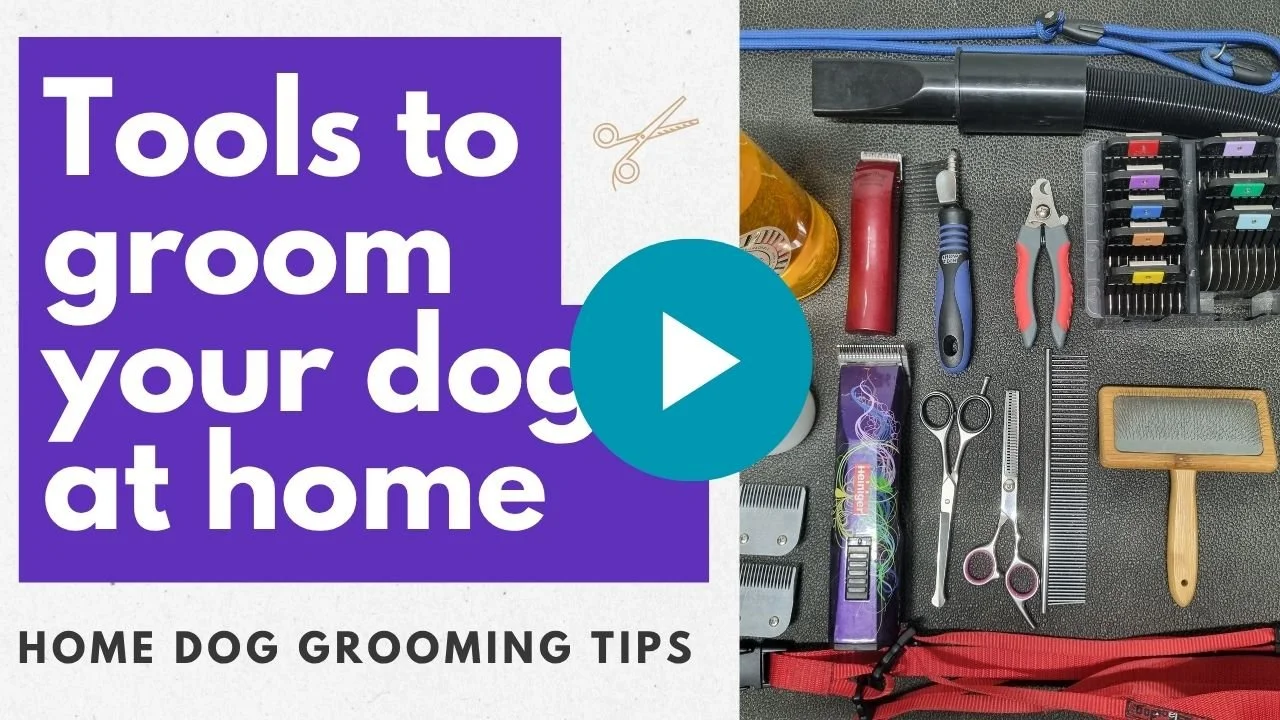
Watch my video below, where I'll show you every tool I use to groom dogs, explain what each one is used for, and share my tips on choosing the right equipment for grooming your dog at home.
7. Scissors with rounded tip
If you’re new to grooming, a pair of dog grooming straight scissors with a round tip is essential. The round tip can help prevent you from accidentally cutting your dog’s skin or paw pads.
8. Scissor and comb set
When I first started grooming, I bought a basic scissor and comb set. It was an affordable way to get everything I needed, with several different types of scissors and a grooming comb included.
I use the straight scissors (which don't have rounded tips) for most of my trimming. However, when trimming the fur between a dog's eyes, I always switch to round-tipped safety scissors. If your dog suddenly moves, the rounded tips greatly reduce the risk of accidentally poking them in the eye.
The set also includes a pair of curved scissors, which are perfect for shaping rounded areas such as the feet, tail, ears and around the mouth. They make it much easier to create a soft, natural-looking finish.
Another pair you'll find in the set are thinning shears. These are fantastic for blending the coat and softening harsh scissor lines, particularly around the head, so you achieve a more natural, teddy bear-style finish. They're also great for removing excess bulk in areas where the coat is especially thick, such as around the muzzle.
There’s also a comb, which is one of the handiest tools you'll own. I use it to comb through the tail and ears, lift the fur when trimming around the eyes and face, and create that lovely teddy bear look. After brushing with a slicker brush, I also comb through the entire coat to check for any hidden knots or mats that the brush may have missed.
9. De-matting comb
A de-matting comb is one of the handiest tools in any groomer's kit. The one I use has 11 serrated blades that are designed to safely cut through stubborn mats, tangles and knots with minimal effort. Once you've broken up the mat, simply use a slicker brush to gently brush out the remaining loose fur until the knot is completely gone.
10. Nail clippers
Nail clippers are an essential part of any dog grooming kit. I use a small pair because I mainly groom dogs weighing around 10 kg, although they're also suitable for many larger dogs. If you have a giant breed, you may prefer a larger pair designed for thicker nails.
The clippers I use are comfortable to hold and feature a built-in safety guard, which helps prevent you from cutting the nail too short. This is especially useful if you're new to trimming your dog's nails and want a little extra confidence while you learn.
11. High velocity pet dryer
Using a high velocity pet dryer will dramatically speed up the drying process. While you might be tempted to reach for your own hair dryer, it's not the best option. Dogs have much thinner skin than we do, so the heat from a human hair dryer can easily dry out their skin or, worse, cause burns. Although you can use a human hair dryer on the cool setting, they're nowhere near as powerful as a pet dryer, so it will take much longer to dry your dog's coat.
High velocity pet dryers use powerful airflow rather than high heat to blast water out of the coat. My dryer has three heat settings, high, low and no heat, which is perfect for warmer weather. It also features a variable speed dial, allowing you to adjust the airflow to suit your dog's comfort level, and comes with several interchangeable nozzles for different drying tasks.
12. Grooming belly sling
I use a grooming belly sling for dogs that like to sit down while I'm grooming their back legs. The sling attaches to the grooming arm, with the strap positioned comfortably under the dog's belly. I adjust the straps so their paws remain flat on the grooming table, allowing them to support their own weight while preventing them from sitting down. This makes it much easier to safely and comfortably groom their legs, while also helping the dog feel more secure during the groom.
13. Slip lead
I attach a slip lead to my grooming table to help keep the dog safely in position while I groom. I prefer using a slip lead over the standard grooming loops that came with my table because I can secure it with a quick-release slip knot. This provides an extra layer of safety, if a dog were to accidentally jump or fall from the table, the knot releases, allowing the dog to reach the floor rather than being suspended by the neck and risking serious injury.
14. Grooming jacket
I wear a Groom Tech grooming jacket whenever I'm grooming dogs, and it's one of those items you don't realise you need until you have one. It has a comfortable neckline, a side zip and a handy pocket for your phone. It's also long enough to cover your lower back and bottom, so when you're sitting on a stool, fur doesn't cling to your clothes.
The jacket is made from 100% polyester, which helps repel hair — a huge bonus when you're grooming. There's nothing worse than getting covered in fur, only to have it end up all through your washing machine and stuck to your other clothes.
While it's not waterproof, I find it does a great job of keeping my clothes underneath reasonably dry during bath time.
15. Dog Shampoo and conditioner
I use Vetkleen and Melanie Newman’s dog shampoo and conditioner, but whichever brand you choose, make sure it's specifically designed for dogs. Human shampoo isn't recommended for dogs because their skin has a different pH balance to ours. Our shampoos can be too harsh, potentially stripping away natural oils and causing dryness, irritation or other skin issues.
Regular grooming does more than just keep your dog looking their best — it also plays an important role in their overall health and wellbeing. With the right tools and a consistent grooming routine, you'll be well-equipped to keep your furry friend clean, comfortable and looking their best.
I’m a qualified dog groomer and fur-mum to two cavoodles; Soda and Poppy. I’m passionate about the health and wellbeing of dogs, as well as helping dog parents groom their dogs at home. I’ll teach you the basics, however if you don’t feel comfortable or confident at any time that’s completely fine, book your dog in for a regular groom and pamper session at the salon. Please never leave your dog unattended on a grooming table.
Disclosure: Healthy Happy Paws is a reader supported website. If you purchase products through links on this website we may earn a small commission at no additional cost to you.