
How to trim your dog’s tail at home

A dog's tail can easily become dirty, tangled and matted, so regular washing, brushing and trimming are all part of keeping it healthy and looking its best. Dogs with short coats generally need very little tail maintenance, while those with long, fluffy tails will benefit from regular grooming.
There are five common tail styles you'll see in the grooming world: pom-pom, carrot, plume, natural and flag.
Pom-pom tails are most commonly seen on Poodles, while West Highland White Terriers and Scottish Terriers are often groomed with a carrot-style tail. Shih Tzus, Maltese and Bichon Frisés typically have a plume tail, which is left long and flowing. Schnauzers and Cocker Spaniels usually wear a natural tail, while Golden Retrievers and many popular crossbreeds, including Cavoodles, Spoodles and Groodles, are often groomed with a flag-style tail.
Since I groom plenty of Cavoodles, today I'm going to show you how to trim a flag-style tail. And to help with the demonstration, Poppy and Soda have kindly volunteered to be my models!
What you’ll need:
De-matting comb if your dog’s tail is knotty or matted
How to trim a dog’s tail at home
The first thing you need to do is brush your dog’s tail to remove any knots or matting.
[1] The best type of brush for this is a slicker brush. Try not to brush your dog’s tailbone, instead hold the tailbone with your hand and brush the hair away from your dog. Brush one side of the tail and then the other. Once the top layer of fur is brushed, push it aside and brush the fur underneath.
[2] If you come across a knot or matting, if it’s small, you might be able to brush it out with the slicker brush. If not, you could try cutting into it with scissors to break it up and then you might be able to brush it out. Or, and this is my preferred option, you could use a de-matting comb. A de-matting comb is a groomer’s best friend. Its serrated blades easily cut through matting, tangles and knots. You’ll see in the photo below Poppy has a mat near the base of her tail. I made sure I held her tailbone and the fur above the matting so she wouldn’t feel the pulling and I used the de-matting comb to break up the matting until I could brush through it with the slicker brush.
If the matting is large, trying to brush it out can be too painful for your dog, so it’s best to cut it off. This might leave the tail looking a bit uneven with a section missing – but that’s fine, home grooming is all about keeping your dog comfortable, you’re not entering them into a grooming competition, and their fur will grow back in no time.


[3] Once you’ve finished brushing through their tail with the slicker brush you shouldn’t have any knots or matting.
[4] Next, comb through their tail to check for any hidden knots of matting. If the comb gets stuck it means there’s still a knot for you to get out.


Many dogs are quite sensitive about having their tail handled. Some will spin around in circles to avoid you, while others will simply sit down. If your dog keeps turning around, it can be helpful to have someone gently hold them while you work. If they decide to sit, that's perfectly fine - you can still brush and comb through their tail while they're seated, just like I've done with Soda below.


[5] Now it's time to create the flag shape. An easy way to do this is to wrap your fingers around the base of the tail and slide your hand down towards the tip, gathering the fur as you go. Once you reach the tip of the tailbone, hold it securely between your fingers to protect it from the scissors. Then twist the excess fur and trim it off.
[6] Next, comb the tail again so the fur falls naturally. You'll see that the cut you just made has created the foundation of the flag shape, making it much easier to refine and neaten in the next step.


[7] Using your curved scissors, follow the shape of the flag and trim the rest of the tail. If the tail fur is thick, you may need to trim one side of the tail and then the other. Once you’ve finished, re-comb the tail and trim any stragglers or uneven sections.
[8] Ta-da! Nice job, your dog’s tails should look like a nicely shaped flag like Poppy’s.


Tips for shaping a flag style tail
Brush any knots and mats out before you start trimming
You might need a second pair of hands to hold your dog still
I highly recommend a de-matting comb to remove matting
Hold the tailbone while you brush to prevent the hair pulling and hurting your dog
Always re-brush and trim twice, you always seem to miss a stray hair or two!
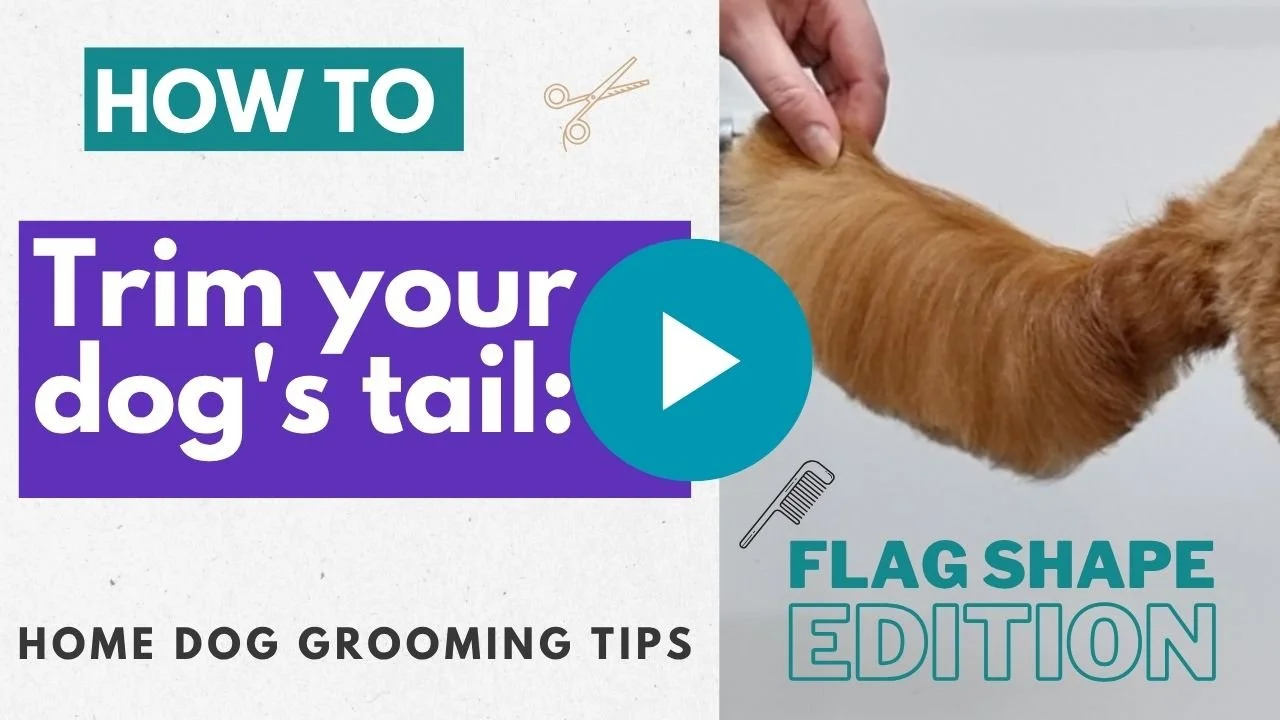
Watch my step-by-step video tutorial
Want to see exactly how it's done? Watch my step-by-step video where I demonstrate how to trim your dog's tail into a beautiful flag shape. I'll guide you through the techniques I use and the tips that help achieve a neat, professional-looking result. Whether you're grooming your dog's tail for the first time or refining your technique, this video will give you the confidence to create a tidy, well-shaped flag tail at home.
If you’re feeling game, and you think you’d like a shorter tail you can always keep trimming. I like to keep Soda’s tail short because it gets matted really easily and she picks up a lot of debris from outside and brings it inside the house. So I trim her tail into a carrot shape. Have a look at her below, I think she looks pretty cute ☺
Just remember there’s no such thing as over-trimming. If you go a little too short and you’re not happy with it, don’t worry, it will grow back before you know it.

Soda groomed with a carrot style tail
I’m a qualified dog groomer and fur-mum to two cavoodles; Soda and Poppy. I’m passionate about the health and wellbeing of dogs, as well as helping dog parents groom their dogs at home. I’ll teach you the basics, however if you don’t feel comfortable or confident at any time that’s completely fine, book your dog in for a regular groom and pamper session at the salon. Please never leave your dog unattended on a grooming table.
Disclosure: Healthy Happy Paws is a reader supported website. If you purchase products through links on this website we may earn a small commission at no additional cost to you.